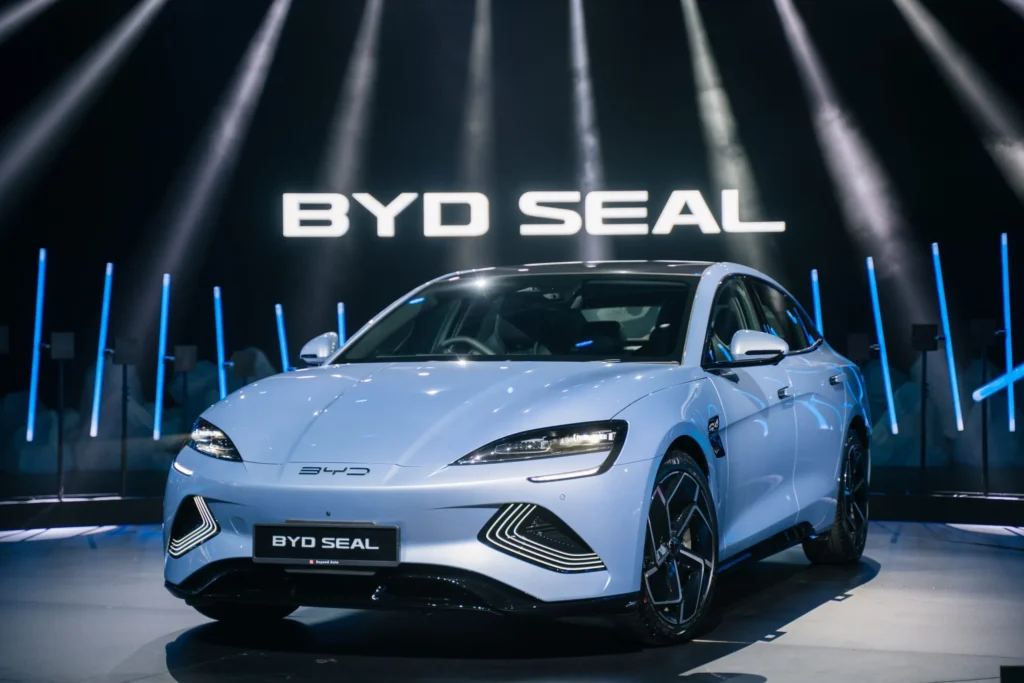
This year, More than 70,000 unsold Chinese electric vehicles (EVs) have piled up at Brazilian ports, signaling that Chinese automakers are facing a tough challenge in maintaining strong growth.
Companies like BYD and Great Wall Motor have globalization ambitions, and Brazil has become a key testing ground against a backdrop of a shift toward protectionism in many major economies.As the world’s sixth-largest auto market, success in Brazil could significantly boost their prospects across the region.
However, after successfully penetrating Brazil, an emerging market for electric vehicles, Chinese automakers are facing increasing challenges. The cars are piling up in ports to avoid new tariffs.And local competitors have responded by increasing EV options and investment.In addition, EV growth in Brazil is slowing down as it has in much of the world.
“The bonanza is over,” said Alexander Seitz, chairman of the executive board of Volkswagen AG’s South American unit.VW has sold cars in Brazil since the 1950s and has produced some of the country’s best-selling fuel-efficient vehicles.
BYD is on track to top $100 billion in sales this year, and Brazil accounts for a large portion of that.Brazil is BYD’s largest overseas market, as the company has faced resistance in those markets amid boycotts by U.S. and European governments.
In the last decade, Brazil exempted electric and hybrid vehicles from a 35% import tax in order to promote the electric vehicle industry. That attracted Chinese automakers and essentially created a market for them.In a country with a population of more than 200 million, traditionally homegrown manufacturers – almost exclusively subsidiaries of global companies like General Motors – have virtually ignored EVs and hybrids.
BYD introduced its first cars to Brazil in 2021 and accelerated exports last year.Its lowest-priced model sells for as little as 115,800 reais (about $19,100), which is cheaper than traditional fuel cars, and has quickly captured market share. Domestic manufacturers have responded by reducing the prices of some models by as much as 30 percent.
Brazilian automakers lobbied for the reinstatement of the import tax and eventually won the support of President Luiz Inacio Lula da Silva. Lula’s government returned to power in January 2023 and began resuming the tax a year later at a rate of 10%, with a plan to gradually increase it to 35% by mid-2026 (the domestic industry is pushing for accelerated implementation).
In response to the tariffs, BYD exported a large number of cars to Brazil before the tariffs were implemented. Earlier this year, in November, a BYD executive said there were still about 35,000 vehicles left at the port, equivalent to about four months of inventory. Alexandre Baldy, senior vice president of BYD’s Brazilian unit, said this was all part of an advance program to maintain a price advantage in the face of an “outdated” domestic industry.
” We have so completely rocked the Brazilian automotive market that we have filled our competitors with fear,” Baldi said in the interview.”It’s total desperation on the part of the competitors.”
According to the Brazilian Automobile Manufacturers Association (Anfavea), the share of EVs in total Brazilian car sales almost doubled from 3.5% in the same period last year to 7% in January of this year, but has largely remained at that level since then. Between January and October of this year, total car sales in Brazil totaled about 2 million units, of which EVs accounted for about 140,000 units.
In a country that is just beginning to build charging stations, it is becoming increasingly difficult to find new consumers willing to buy electric vehicles.In addition, Brazil’s vast size and long distances between cities exacerbate concerns about EV range.
“We need to expand our infrastructure,” said Ricardo Bastos, Great Wall Motor’s head of government affairs in Brazil.”Sales are good today, but if the infrastructure keeps up, the market potential will be even greater.“
To accelerate penetration, BYD and Great Wall Motor plan to become more aggressive in 2025.Both companies plan to build factories in Brazil.
BYD expects to start production in Brazil next March, its first electric car plant outside Asia.The company is investing 5.5 billion reais (about $1.1 billion) at the site of a former Ford Motor plant, which is expected to produce 300,000 vehicles a year for two years.
BYD also said it will double the number of dealerships in Brazil, selling about 12 models, including what the company claims is the market’s first hybrid pickup truck, which was released in October.
Meanwhile, Great Wall Motors expects to begin operations at the former Daimler plant in May next year and plans to invest 10 billion reais (about $1.6 billion) over the next decade.
Other Chinese companies are also planning to enter the Brazilian market in response to tough tariffs in Europe and the United States. Earlier this year, the Biden administration in the U.S. raised tariffs on Chinese imports of electric cars to 100 percent from 25 percent to protect the country’s auto industry.Other Chinese companies are also planning to enter the Brazilian market in response to tough tariffs in Europe and the United States. Earlier this year, the Biden administration in the U.S. raised tariffs on Chinese imports of electric cars to 100 percent from 25 percent to protect the country’s auto industry.
Chery Automotive’s (Chery Automotive) Omoda and Jaecoo plan to launch several models in Brazil by 2026.Guangzhou Automobile (GAC) has committed to invest about R$6 billion ($1 billion). Ne Zha Automobile (NETA), which is linked to Hozon New Energy Automobile, is also entering the Brazilian market.Geely’s Zeekr has recently begun launching premium models in Brazil.
Established automakers including Volkswagen, Toyota and Renault plan to invest more than 100 billion reais (about $20 billion) by the end of the century, with most of the money going toward the development of hybrid models, including flexible solutions combining electricity with Brazilian sugarcane ethanol fuel.
Stellantis Group, which owns the Fiat, Jeep and Peugeot brands, plans to start selling electric models from its Chinese partner Leapmotor in Brazil early next year.
Prior to the introduction of the EV import tax, Chinese carmakers were not “competing on the same terms” as local companies, said Emanuele Cappellano, chief operating officer of Stellantis South America.
We use cookies to ensure that we give you the best experience on our website. If you continue to use this site we will assume that you are happy with it.