ALGIERS, May 16 (Xinhua) — Sitting on the world’s 10th largest territory, Algeria’s energy reserves rank 16th in the world and natural gas reserves rank ninth in the world, and energy exports are an important pillar of its economy.However, since 2014, affected by the sharp fluctuations in international oil prices, Algeria’s foreign exchange reserves plummeted.The Government has begun to actively seek economic diversification, promoting the upgrading of the manufacturing sector, the modernization of agriculture and the development of the tourism industry, as well as severely restricting imports through policies such as high tariffs and import quotas, with a view to reducing the loss of foreign exchange reserves and fostering localized production.
While the policy of restricting imports has reduced the loss of foreign exchange and protected local industries in the short term, the lag in production capacity has inevitably led to shortages of commodities and soaring prices, and Algeria is experiencing the pains of economic transition.
This is a July 10, 2023 cityscape of Algiers, the capital of Algeria.
Shortage of consumer goods
When he first arrived in Algeria’s capital, Algiers, a Xinhua reporter was shocked by the prices of goods in local Chinese supermarkets: a bottle of 500 ml soy sauce sold for as much as 1,700 dinars (about 93 yuan), a bag of instant noodles was priced at 400 dinars (22 yuan), and a bag of 5 kilograms of northeastern rice cost 5,500 dinars (302 yuan).
The shortage of consumer goods has had a real impact on the lives of local people.The owner of a local import supermarket said: “Due to the implementation of the import quota system, local customs are very strict on imported goods, and it is very difficult for goods to be transported in, and sometimes the customs clearance cycle lasts several months or even half a year, which doubles the cost and naturally raises the price.
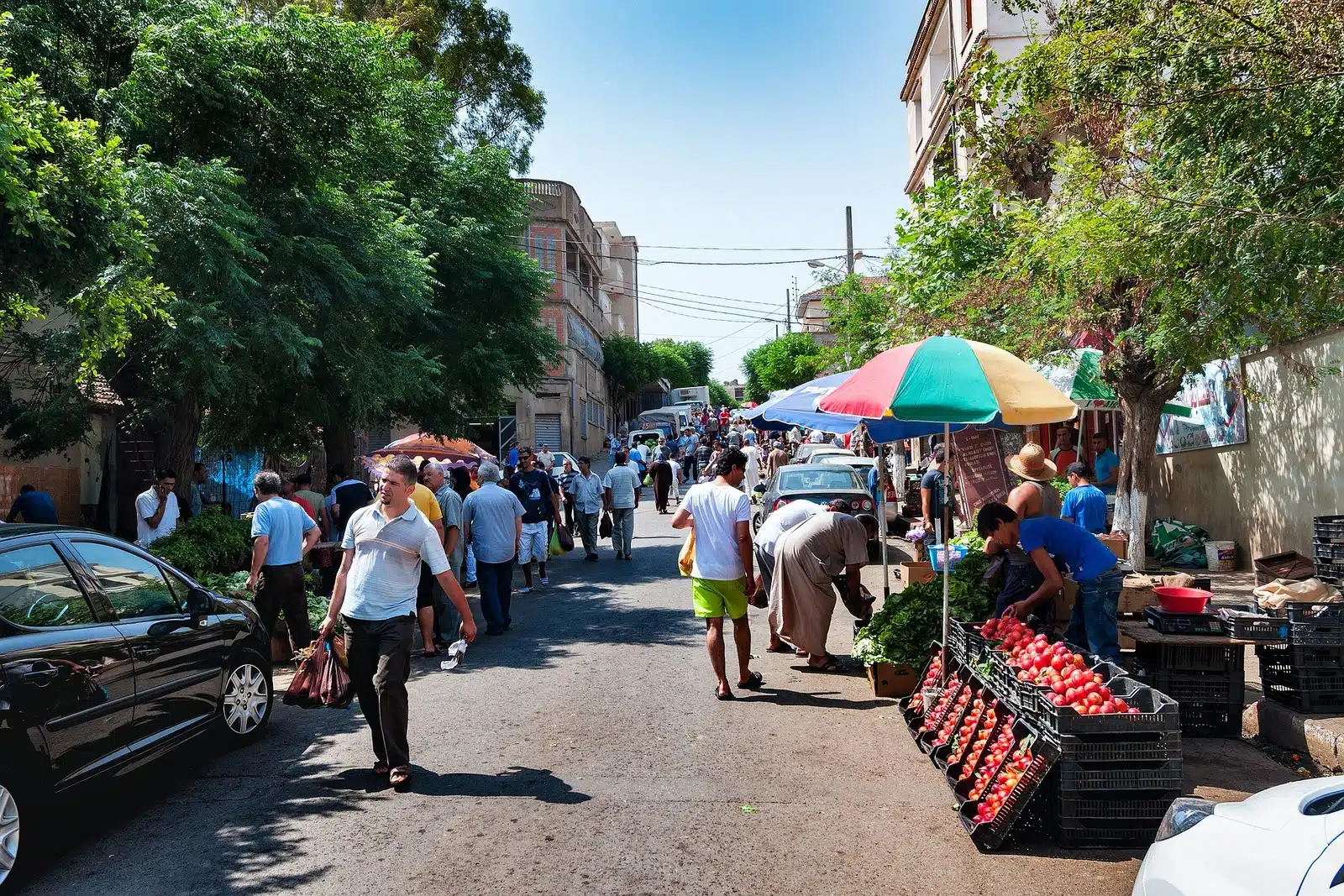
People visit a fruit and vegetable exhibition on October 3, 2024 in the Algerian capital Algiers.
At present, a considerable number of the cars running through the streets of Algiers are worn-out “classic cars” that are more than 20 years old.Not long ago, in a second-hand car sales market in Algiers, 45-year-old Abdullah Karim was worried.His family car purchased more than 20 years ago, recently he wanted to replace a newer second-hand car, but in the second-hand car market turn for three days is still nothing, because the price of the car on the market compared with a few years ago almost doubled.
“A used car made in 2017 now costs 4.5 million dinars (R250,000), which is way beyond my means.”He said helplessly.
The Algerian government first introduced an import quota system in 2016, limiting annual car imports to about 150,000 units, a significant reduction from the previous scale of about 400,000 to 500,000 units per year.In subsequent years, quotas have been tightened and, at one point, the issuance of car import licenses was even halted.
Import quotas “double-edged sword”
Algeria’s current import quota measures include: limiting the number of imported goods, with the Government setting annual import quotas for specific goods; establishing an import licensing system, whereby importers are required to apply for a license from the Government in order to import goods within the scope of the quota; and encouraging localized production, with the quota system linked to an industrial policy that encourages foreign-owned firms to invest in Algeria to build factories, produce or assemble products.
This is a July 10, 2023 photo of the port of Algiers, Algeria.
By severely restricting imports, Algeria’s foreign exchange outflows have been effectively controlled and its foreign exchange reserves have gradually recovered.According to Algerian government data, between 2020 and 2023, Algeria’s imports fell from $56 billion to $35 billion, a decline of more than 35%.Meanwhile, the country’s foreign exchange reserves rebounded from $61 billion in 2022 to $71.8 billion in 2024.In addition, Algeria’s localized production capacity for light industrial goods, such as general daily necessities and household appliances, has increased significantly.
At present, the economic transformation is beginning to show results, but there are serious shortages of automobiles, high-end electronic products and some medicines.Due to the lack of mature supply chains and skilled workers in some of these industries, etc., Algeria is unlikely to be able to achieve large-scale localized production overnight.
A head of a foreign-funded company who wished to remain anonymous told reporters, “Although the government encourages foreign companies to invest and build factories locally, bureaucracy in the implementation of the policy, insufficient infrastructure, lack of skilled personnel, and restrictions on imported spare parts have constrained the speed of the advancement of localized production.”
An International Monetary Fund report concluded that Algeria’s economic reform process remains slow and structural obstacles have not been eradicated.Weak policy implementation could lead to further economic downturns and social discontent.
Sticking to the path of transformation
Despite the difficulties, the Algerian government has continued to transform the economy and to adjust and optimize its policies.2023 The Algerian government has announced a series of new measures, including increased support for small and medium-sized enterprises (SMEs), a reduction in tariffs on imports of production materials, and increased investment in the renewable energy sector.
Visitors look at exhibits at the Cultural Heritage Show on February 22, 2024 in the Algerian capital Algiers.
A number of Algerian economists said in an interview with the reporter that economic transformation is a long-term and difficult battle.In the short term, the shortage of commodities is an inevitable pain, but if the Algerian government can formulate a clearer industrial development plan, and the introduction of supporting policy support, it is entirely possible to establish a healthier economic structure.
According to geo-economist Abdel Rahman Khadif, Algeria has the potential to join the ranks of emerging economies by 2030, and what needs to be done now is to accelerate the reform process and further improve the business environment.
According to the Algerian government’s expectations, the country’s GDP growth rate will increase to 4.5% in 2025 from 4.2% in 2024, with exports reaching $50.9 billion, imports at $46.07 billion, and foreign exchange reserves reaching $72.95 billion.
In interviews, journalists have found that, at present, part of the Algerian population believes that, despite the short-term pains it is facing, the country is on an uphill path and trusts that the future will be better, while others expect the Government’s reforms to bring about real results and hope that the results will come more quickly.
We use cookies to ensure that we give you the best experience on our website. If you continue to use this site we will assume that you are happy with it.